
The Slippery Rock Where Paul Stood
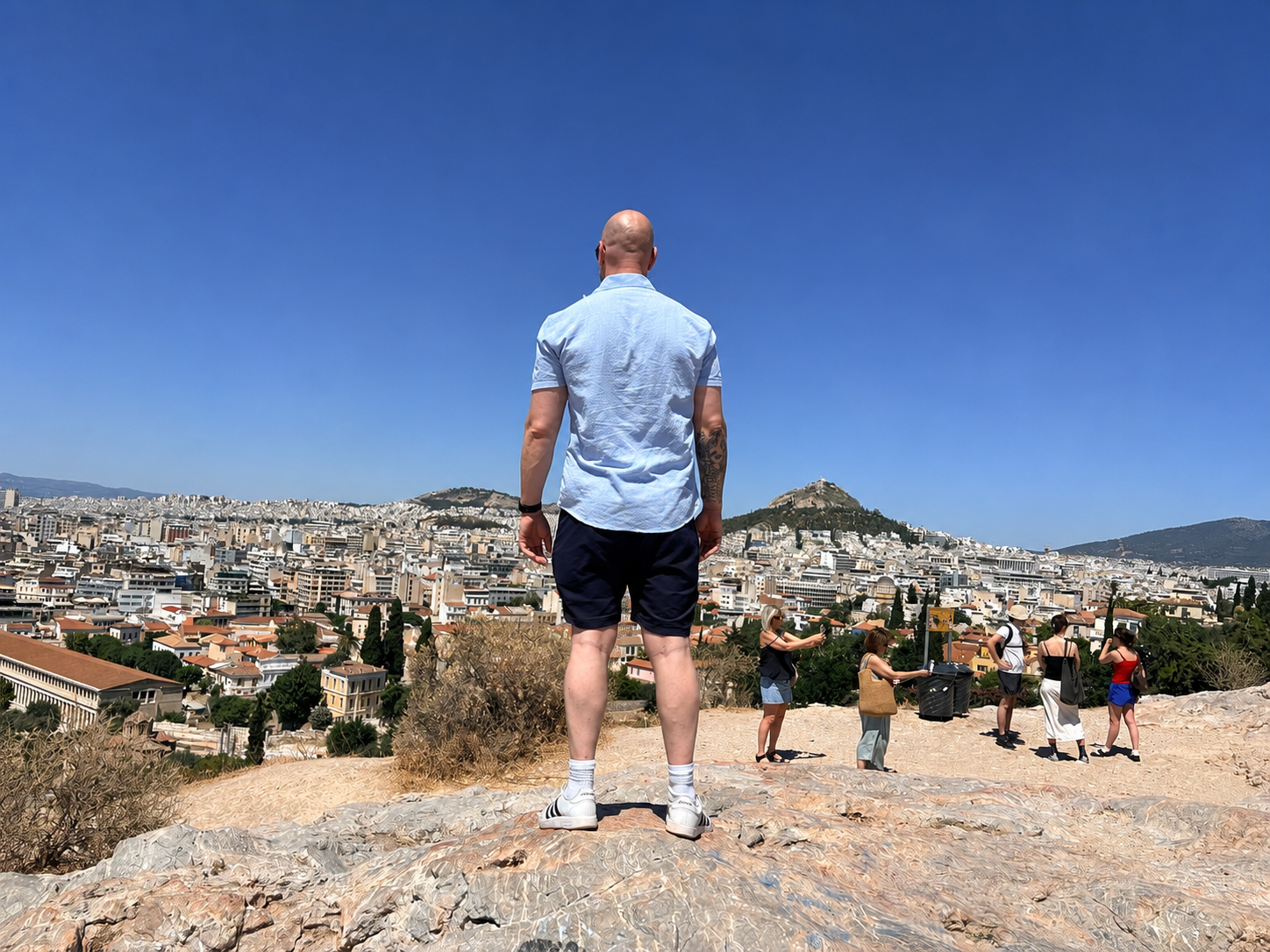
Last weekend I visited the Areopagus in Athens.
If the name doesn’t immediately ring a bell, it’s the place most people know as Mars Hill, where the Apostle Paul stood in Acts 17 and addressed the philosophers, intellectuals and religious thinkers of ancient Greece.
If I’m honest, I had imagined something a little more dramatic. Perhaps a grand platform, an impressive monument, or at the very least a rock that didn’t feel like it was actively trying to throw me down a hill. Instead, what I found was a surprisingly slippery lump of stone. After a couple of thousand years of tourists, pilgrims and curious Christians retracing Paul’s steps, the surface has been polished smoother than my freshly shaved head. One wrong step and I could easily have found myself recreating the Fall in a very literal sense.
In some ways it was underwhelming. It’s just a rock. And yet at the same time it felt deeply profound. I was standing where Paul stood. Not a statue of Paul. Not a memorial to Paul. The actual place where he stood and preached the gospel nearly two thousand years ago. The feeling hit me almost immediately, but it has only deepened as I’ve reflected on it since. This wasn’t just any historical figure. This was a man who met the risen Jesus face to face. A man who gave his life carrying the gospel across the Roman Empire. A man who, under the inspiration of the Holy Spirit, wrote a huge portion of the New Testament that sits on my desk at home. My feet were standing where his feet once stood. That’s not something you forget in a hurry.
Looking Through Paul’s Eyes
As I stood there looking across Athens, I found myself trying to imagine what Paul would have seen. Not ruins, but temples. Not broken columns, but magnificent buildings gleaming in the Mediterranean sun. Not tourist attractions, but living monuments to power, religion and human achievement. The following day I climbed up to the Acropolis and looked down on the Areopagus below. Standing there, the scale of the ancient city suddenly hit me in a way it hadn’t before.
Athens wasn’t merely impressive by ancient standards. In many ways, Athens set the standards. While much of the world was focused on survival, the Greeks were debating philosophy, shaping democracy, producing great thinkers and building structures that still leave people speechless thousands of years later. Standing on the Acropolis, looking out across what was once one of the most powerful and influential cities in the world, I found myself feeling something unexpected: sympathy.
Not sympathy for their religion or their paganism, but sympathy for the temptation they faced. If I had been born an Athenian, would I really have been any less impressed with myself than they were? I’m not sure I would. When your civilisation is producing Plato, Aristotle and Socrates while much of the known world is still living a far simpler existence, it’s easy to start believing you’re the smartest people in the room. Athens wasn’t just wealthy. It wasn’t just influential. It was intellectually intimidating.
Which makes Paul’s visit all the more remarkable.
Paul arrives in one of the intellectual capitals of the world with no army, no political influence, no wealth and no credentials that would have impressed the Greek elite. He simply arrives with the gospel. As I imagined him standing there, looking out over the city, I didn’t picture him feeling intimidated. If anything, Paul reminds me a little of John the Baptist. There is an unswerving confidence about him. Not confidence in himself, but confidence in God, confidence in his calling and confidence in the truth of the gospel. He seems utterly convinced that what he carries is more valuable than everything Athens believes it already knows.
More Religious Than We Think
One of the most famous lines in Paul’s speech is this: “Men of Athens, I notice that you are very religious in every way” (Acts 17:22, NLT).
Standing on the Areopagus, I couldn’t help thinking that those words are every bit as relevant today as they were then. We often describe the modern West as secular, post-Christian or increasingly non-religious. I’m not convinced. The Athenians weren’t necessarily more religious than we are. They were simply more honest about it.
Their idols were easier to spot. They built temples and statues. We build stadiums, arenas and platforms. They had philosophers. We have influencers. They had gods dedicated to power, beauty, pleasure and wealth. We have entire industries built around pursuing exactly the same things. The names have changed, but the promises haven’t.
Perhaps the greatest idol of modern Western culture is the self. We are constantly encouraged to look inward for truth, purpose and identity. Follow your heart. Live your truth. Be your authentic self. The highest authority isn’t God, Scripture or tradition. Increasingly, it’s whatever version of ourselves we happen to discover in the moment. The self has become both priest and deity.
And yet, despite all our technological advances, material prosperity and personal freedom, people seem no less restless than they were two thousand years ago. We are still searching for meaning. Still searching for purpose. Still searching for fulfilment. We still carry that nagging sense that there must be something more.
The Unknown God
What fascinates me most about Paul’s speech is that he doesn’t begin by mocking the Athenians. He doesn’t ridicule them for believing the wrong things. He doesn’t dismiss them as foolish. Instead, he notices something deeper. Beneath all the temples, all the idols and all the philosophy, he sees a genuine search.
Paul points to an altar bearing the inscription, “To an Unknown God” (Acts 17:23, NLT). Think about that for a moment. Athens had gods for everything. Gods for war, love, wisdom, harvests, the sea and just about everything else they could think of. Yet even with all that, they still worried there might be one they’d missed. There was still a gap. Still a question mark. Still a sense that something wasn’t quite complete.
It’s hard not to see ourselves in that.
Our culture is constantly trying to fill a void. We search through success, relationships, experiences, possessions, politics, achievement and endless self-improvement. None of those things are necessarily bad, but they make terrible gods. Much of what passes for culture today is really worship. Humanity searching for something ultimate. Searching for something true. Searching for something that finally satisfies.
As I stood on the Areopagus and later looked down on it from the Acropolis, I couldn’t shake the feeling that Paul’s message is more relevant now than ever. The modern world may congratulate itself on moving beyond religion, but we’re still worshipping. We still build our lives around things that promise fulfilment but struggle to deliver it. We still create idols, even if they’re less obvious than marble statues.
The Same Message
I also couldn’t shake the feeling that if Paul walked through London, New York, Los Angeles or Dubai today, he would probably say much the same thing he said in Athens.
Not with anger. Not with contempt. But with the confidence of a man who knew he had found the answer.
Our job as Christians isn’t to condemn people for searching. The longing is real. The hunger is real. The sense that something is missing is real. Most of us have searched in all sorts of places ourselves. Our job is simply to point people towards the One they have been looking for all along.
The unknown God is unknown no longer.
The void we keep trying to fill isn’t ultimately calling us to discover ourselves. It’s calling us to discover Christ.
And perhaps that’s what struck me most as I stood on that slippery rock where Paul once stood. Two thousand years have passed. Empires have risen and fallen. Athens has become a tourist destination. The temples lie in ruins. The philosophers are studied in textbooks.
But the gospel Paul preached that day is still changing lives.
And that tells us something important about where true wisdom is found.